
I am amazed at how quickly AI has moved onto the agenda at the board level. Last week I had a very insightful conversation with the CEO of a PE-backed speciality distributor doing about $350m in revenues. His board is pushing for detailed AI programs to reduce costs. In another recent conversation with the SVP of Digital at a large European distributor, their C-suite is asking about AI enablement strategies. AI is on the agenda, and B2B executives now need to determine where to invest first: the data and systems that make AI usable, the AI already available inside commerce applications, or custom AI built around the company’s specific operating model.
At Cadent Commerce, we use a 3-tier pyramid to organize that decision. The base tier is AI-ready data, systems, and tools. The middle tier is subscribed commerce applications with AI built in. The top tier is custom AI for business requirements that standard platforms can’t address well.
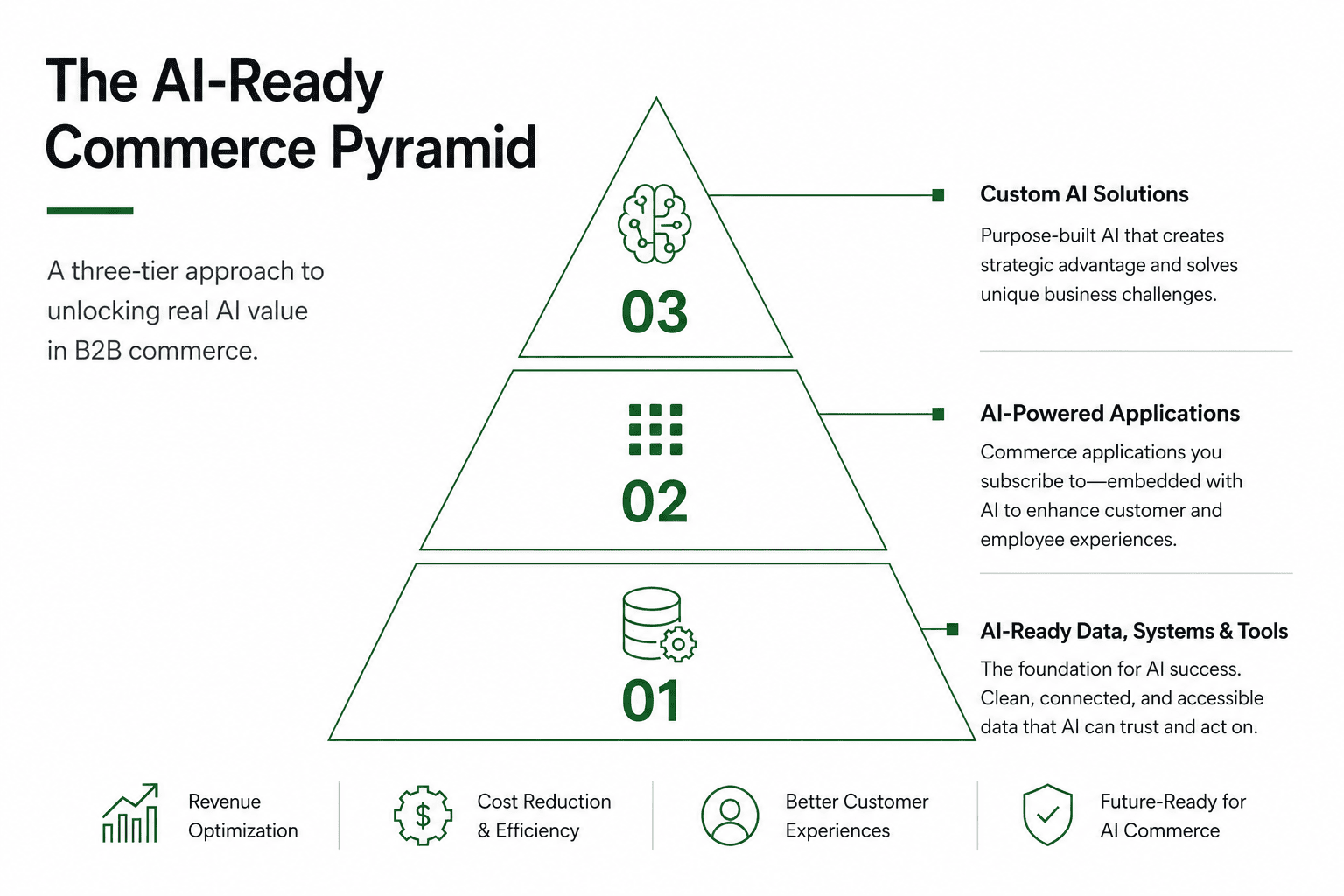
Why this construct? AI in commerce depends on the information that it can access. Product data, category logic, customer rules, inventory, pricing, shipping commitments, and order workflows determine whether AI can support the customer experience or the employee workflow in a reliable way.
Tier 1: AI-ready data, systems, and tools
The base tier supports every serious use of AI in commerce, both inside the business and in the market. Internally, it gives teams (human and AI agents) the inputs needed for revenue optimization, cost reduction, workflow efficiency, merchandising decisions, order processing, and service operations. Externally, it determines whether the company can appear accurately in AI-assisted buying experiences.
That external requirement is becoming more important. Search engines, AI answer engines, commerce agents, and MCP-enabled experiences all depend on trusted source data. Clean product data, accessible inventory, customer-specific pricing, shipping logic, application guidance, and capabilities information need to be structured, current, and available to the systems customers use to research and buy.
For many B2B companies, this is where the hardest work sits. Product information may live across a PIM, ERP, CMS, DAM, PDFs, spreadsheets, and sales team knowledge. Pricing may depend on contract terms, customer groups, volume breaks, margin rules, region, or availability. Inventory may vary by warehouse, branch, supplier, allocation rule, or promised delivery date.
AI can’t reliably support a complex commerce model unless those facts are usable. A manufacturer selling replacement parts needs compatibility data. A distributor needs substitutions, lead times, branch-level availability, and account eligibility. An industrial brand needs technical specifications, safety documents, application guidance, and customer-specific terms.
The base tier includes product attributes, category content, comparison content, FAQs, buying guides, shipping dates, inventory availability, customer-specific pricing, account permissions, and the integrations that expose those facts to the commerce experience. It also includes the governance needed to decide which facts can be used by which systems, in which customer contexts, and with what level of human review.
For companies that want to address any issues with their base layer, start by running a base-tier readiness audit around high-value buying workflows, such as whether a customer can find the right product, confirm compatibility, see their price, check availability, and understand when it can ship. Trace every fact AI would need to answer that reliably, including product data, category content, compatibility rules, inventory, customer-specific pricing, lead times, account permissions, and source systems such as PIM, ERP, OMS, CMS, DAM, CRM, and the commerce platform. Then score each input for completeness, freshness, structure, and accessibility. The output should be a readiness map that shows missing data, weak content, disconnected systems, unclear ownership, and high-risk logic that must be fixed before AI can support revenue, efficiency, customer experience, AI answer engines, and MCP-enabled commerce. From there, you can put in place a plan to address the gaps.
Tier 2: AI inside commerce applications
The second tier includes the AI capabilities already present inside the platforms companies license. This is often where AI first reaches the business because the functionality comes through an existing vendor relationship.
A PIM may give users AI tools to expand product content, or translate it. A feed management platform may prepare product data for marketplaces, paid media, retail media, or AI commerce surfaces. A search platform may use AI to personalize results and recommendations. An order intake tool may read purchase orders, identify exceptions, and route orders into downstream systems.
For example, Feedonomics says its platform moves product data from source systems to more than 400 channels, marketplaces, and AI surfaces. Algolia describes its personalization capability as responding to user signals across search, browse, recommendations, and other touchpoints.
These application-level capabilities can improve the customer experience when the base tier is strong. A PIM can draft better content when attributes are complete. A search platform can return better results when the catalog is well-structured. A feed platform can distribute products more effectively when titles, descriptions, categories, images, inventory, and availability are accurate.
A practical first step is an application AI audit. Leaders should identify which AI capabilities already exist in the commerce stack, which ones are active, which teams own them, which use cases affect customers, and which inputs each capability requires. Many companies already pay for AI features they use lightly because ownership, data quality, or system access remains unclear.
Tier 3: Custom AI for strategic advantage
The top tier is custom AI. This is where a company builds around requirements that packaged platforms can’t handle well. In B2B, those requirements usually come from the operating model: account-specific terms, negotiated pricing, configured products, approval workflows, replacement logic, fulfillment constraints, and high-consideration buying decisions, or unique tools that convey experience advantages.
A custom product advisor may need to understand compatibility rules, account eligibility, contract pricing, inventory, and recommended substitutes. A quote assistant may need configuration logic, margin rules, approval thresholds, customer history, and ERP data. An order automation workflow may need to read a purchase order, validate terms, flag exceptions, check inventory, and route clean orders into the right system.
This is where AI can create an advantage that competitors can’t copy through the same off-the-shelf feature. The company applies AI to the rules, workflows, and customer moments that define how its business operates. Cadent Commerce’s work sits in that same operating reality, with B2B use cases spanning customer-specific pricing and catalogs, account-based purchasing, ERP, CRM, fulfillment integrations, and custom applications for specific business challenges.
Custom AI should meet a high bar. It should have a clear value proposition, a clear business owner, a defined system path, trusted inputs, review rules, and a measurable workflow outcome. Narrow use cases are usually the right starting point: answer a custom pricing question, ingest a purchase order, recommend a substitute product, or draft a quote based on inputs from multiple systems.
How leaders should use the pyramid
The pyramid gives B2B leaders a sequence for investment. Start by assessing product data, category content, inventory, pricing, shipping logic, account rules, and system integrations. Include customer-facing content and internal operations data in the same review because AI will draw from both.
Then audit the applications already in the stack: PIM, commerce platform, search, feed management, CRM, service tools, OMS, ERP connections, and analytics. Identify the AI capabilities available today, the use cases they support, the teams that own them, and the data they need.
Custom AI should come after that work has exposed the gaps. The best candidates are workflows where the business model creates requirements that standard tools can’t satisfy, the data can be trusted, and the outcome can be measured.
For B2B commerce, AI readiness starts below the customer interface. Prepare the data. Connect the systems. Use the AI already inside the stack. Build custom AI where the company’s business model demands it.
Cadent Commerce helps B2B companies translate complex product, customer, order, and operational logic into commerce experiences built for how their business actually works. Get started.